Our Team
- Organisations
-
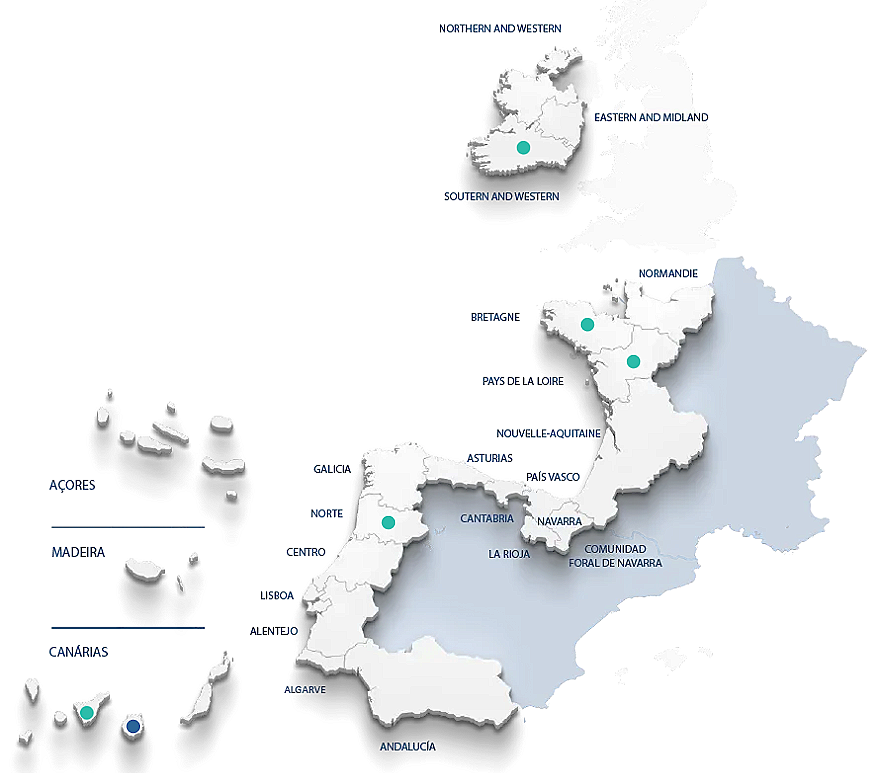
PLOCAN is the Oceanic Platform of the Canary Islands, a Spanish public research infrastructure dedicated to ocean observation and marine technology. Its focus includes marine monitoring, innovation in ocean technologies, and supporting environmental and risk-management initiatives. PLOCAN is the lead partner coordinating the ATLAS project. It oversees DAS deployments and provides validating platforms in the Canary Islands. It manages site preparation, logistics, and regulatory arrangements for the Canary Islands. PLOCAN will operate a DAS interrogator and infrastructures deployed on CANALINK submarine cables. PLOCAN aims to maintain long-term operation of DAS monitoring after the project ends. PLOCAN supports data acquisition and seismic service integration with national monitoring networks. It hosts the Virtual Research Environment (VRE) for ATLAS data access. Finally PLOCAN also contributes to EU-wide integration via EMSO ERIC and Copernicus-linked frameworks.
For information more visit the PLOCAN website. -
There are two ATLAS partners from University College Cork, the Tyndall Institute and MaREI center.
The Tyndall National Institute is a leading research centre in Ireland specialising in information and communications technology, electronics, and advanced materials. Based in Cork and affiliated with University College Cork, Tyndall brings together scientists, engineers, and industry partners to drive innovation from fundamental research through to real-world applications.
In ATLAS, Tyndall leads distributed acoustic sensing (DAS) activities in Ireland, using existing submarine fibre-optic cables as large-scale ocean sensors. By validating DAS performance through field trials and supporting data integration across the project, Tyndall helps deliver robust, field-proven sensing technologies for future European ocean monitoring.
For more information visit the Tyndall Institute website.
MaREI, the Research Ireland Centre for Energy, Climate and Marine research and innovation co-ordinated by the Sustainability Institute at University College Cork. The Centre comprises over 220 researchers focusing on defined global challenges such as the Energy Transition, Climate Action and the Blue Economy.
For information more visit the MaREI website. -
Mood Conseil is a French innovation-support consultancy firm specialized in R&D funding and management. Relying on a team of engineers and PhDs, the firm helps organisations structure, fund, and manage R&D and innovation projects, with a strong emphasis on tax credit, public-funded programmes and multi-partner project. In ATLAS, Mood Conseil brings its expertise in project governance, administrative coordination, financial steering, and compliance with Interreg rules, so that technical and scientific partners can focus on delivery. Mood Conseil is a full project partner involved in supporting overall coordination and acting as co-pilot for administrative and financial project management, facilitating collaboration across countries and ensuring strict reporting and alignment with EU regulations.
For more information visit the Mood Conseil Website.
-
Greenov is a French purpose-driven company founded in 2021 and based in Nantes and Vannes. Our organisation focuses on developing innovative technologies to reduce the environmental impact of human activities at sea. Our core areas of expertise include mitigating underwater noise, preventing ship–cetacean collisions, decarbonising maritime transport, and providing ecological solutions against biofouling and corrosion. As a laureate of multiple European programmes and supported by a team of 21 specialists, Greenov designs operational solutions that balance maritime development with the preservation of marine ecosystems. Within the ATLAS project, Greenov is responsible for conducting acoustic measurements using fibre-optic Distributed Acoustic Sensing (DAS). These measurements support the development of machine-learning-assisted algorithms capable of detecting and classifying cetaceans and vessels near the fibre in real time. Our contribution will enable automated presence alerts, helping to prevent ship–whale collisions via dedicated APIs—such as Whale Alert—and to automatically classify vessel noise emissions. Through ATLAS, we aim to advance large-scale, real-time environmental monitoring to enhance maritime safety and sustainability.
For more information visit the GREENOV website.
-
Item description
-
Submarine telecom operator based in the Canary Islands with thousands of kilometres of fibre optic cable in the archipelago and between the archipelago and the Spanish mainland.
ATLAS participation on:
- User case identification.
- Technical requirements (related to the installation of equipment on fibre optic networks and to the acquisition of new DAS units).
- Providing access to submarine infrastructure to sense marine realm.
- Contribution on market and business evaluation.For more information visit their website.
-
Shom, France's National Hydrographic and Oceanographic Service, provides physical knowledge of the ocean. It measures and describes sea levels, currents, marine sediments, swell, sea temperature, salinity, underwater noise, bathymetry, magnetic fields, etc., and predicts how they will change. Its internationally recognised expertise informs the decisions of sea users and maritime stakeholders. Its products and services meet the needs of the armed forces, ensure the safety of navigators, guide public policy on the sea and coastline, support the development of the blue economy and contribute to the preservation of the marine environment.
Shom, thanks to its Underwater Acoustics Department, has extensive knowledge in acoustic propagation modelling, acoustic data processing, in data annotation, in continuous ambient noise modelling using AIS data and in signal propagation in underwater environments.
Shom has the responsibility of the underwater noise (Descriptor 11) for France for the Maritime Strategy Framework Directive (MSFD). It is therefore highly interested in the use of DAS technology to enhance its sensor network in the EEZ.
Building on its expertise, the Shom is involved in T3.3 and will :
- Achieve the comparison of continuous noise level obtained between traditional sensors (hydrophones and gliders) and DAS.
- Achieve the comparison of impulsive noise events recorded by traditional sensors (hydrophones and gliders) and DAS.
- Achieve the comparison between data recorded by the DAS and models of continuous ambient noise (computed from AIS data provided by Cerema, wind maps, sea conditions or other distant sources).
- Assess DAS performances and accuracy in the estimation of continuous ambient noise levels. Focus on DAS coupling and on the estimation of system sensitivity with respect to ambient noise sources position (e.g. angle dependency of DAS).
- If the ability of DAS for noise characterization is proven, develop a methodology for the integration of DAS technology in the existing acoustic network.
With their expertise on the topic, the Shom will work, in collaboration with the Cerema and Greenov, within this Task T3.4 on:
- The comparison of signatures of vessels obtained between traditional sensors (hydrophones) and DAS.
- The estimation of source level using DAS data inversion and propagation models. The comparison of the results to the motorized data provided in the AIS and Lloyds data to correlate a typology of engines with the generated noise.
- The estimation of ship location, speed and trajectories using DAS data inversion and propagation models. The comparison of positions, speed or trajectory obtained from the DAS data (georeferenced) with those from AIS and Lloyds and the estimation of the margin of error. The detection of ships not equipped with AIS.
- The development of a network for the ship radiated sound monitoring. Analysis of noise level thresholds to consider for marine species well-being. -
Cerema (which stands for Centre for Studies and Expertise on Risks, the Environment, Mobility and Urban Planning) is the major French public agency for developing public expertise in the fields of urban planning, regional cohesion and ecological and energy transition for resilient and climate-neutral cities and regions. Wiithin the ATLAS project they are focused on AIS data processing and marine traffic analysis.
To learn more visit their website.
-
Participated by 8 Member States, EMSO ERIC is a unique marine multidisciplinary, distributed Research Infrastructure, with the goal to explore, monitor and better understand the phenomena happening within and below the oceans and their critical impact on the Earth.
Inserted in the European Strategy Forum on Research Infrastructures (ESFRI) Roadmap in 2006, in 2016 EMSO has the status of European Research Infrastructure Consortium (ERIC) by the European Commission.
EMSO brings together diverse and numerous scientific partners, Institutes and Research Centres operating in key sites in European seas, from North East to the Atlantic, through the Mediterranean, to the Black Sea, in a common strategic framework of scientific facilities (data, instruments, computing and storage capacity) to promote and drive advances in marine science and technology while enabling access to its services, facilities and technology platforms.
EMSO research infrastructure provides relevant information for defining environmental policies based on scientific data, covering a wide range of interdisciplinary areas including biology, geology, chemistry, physics, engineering and computer science, from polar to tropical environments, down to the abyss.
EMSO supports the ATLAS project by performing the following roles:
- Strategic Advisory Role – Providing guidance on aligning project activities with broader European marine research and environmental monitoring strategies, ensuring relevance to EMSO ERIC’s objectives.
- Scientific and Technical Expertise – Offering insights into ocean observation, data collection methodologies, and best practices, particularly related to seafloor and water column monitoring.
- Facilitating Synergies – Connecting ATLAS with other European initiatives, projects, and research infrastructures within EMSO ERIC’s network to enhance collaboration and data exchange.
- Stakeholder Engagement – Representing the project in international discussions and promoting it among policymakers, funding bodies, and scientific communities.
- Data and Knowledge Sharing – Assisting in defining data standards, integrating ATLAS results into broader marine science frameworks, and ensuring interoperability with existing oceanographic infrastructures.
- Policy and Regulatory Alignment – Helping align ATLAS outcomes with European Marine Strategy Framework Directive (MSFD) and other relevant policies
For more information visit the website. -
The Centre for Geophysical Forecasting is hosted by the Electrical Systems Department of the Norwegian University of Science and Technology (NTNU). Our vision is to create sustainable resource monitoring and management technologies. Norway is already at the forefront of global exploration geophysics. CGF leverages that expertise to catalyse a new wave of geophysical capabilities, applying disruptive new technologies, such as Distributed Acoustic Sensing (DAS) to novel enterprises that will be game changers in the transition from hydrocarbon geophysics to the new blue economy, in addition to important terrestrial geohazard risk monitoring and early warning applications, founded on sustainable geophysical applications. CGF is an Associated Partner in ATLAS, providing context and advice on DAS applied to the detection and tracking of shipping and marine mammals, with a view to deconfliction.
For more information visit their website.